

Written by Jonathan Aftalion, Esq. — Founding Attorney, Aftalion Law Group
(UCLA BA, Wisconsin JD, Witwatersrand LLM, dual CA + NY licensure, Super Lawyers Rising Stars)
Key Point:
- Most green card applicants must now leave the United States and complete their application through consular processing at a U.S. embassy abroad, unless they qualify for a narrow extraordinary circumstances exception.
- Departing the U.S. without advance parole while an I-485 is pending can result in case abandonment and trigger a three-year or ten-year bar to reentry for applicants who have accrued unlawful presence.
- Applicants with pending cases, approved family petitions, or employment-based visa status should consult an immigration attorney immediately, because the rule applies broadly to both new and previously filed applications.
The Trump administration has severely restricted adjustment of status, a longstanding pathway that previously allowed foreign nationals already living in the United States to apply for permanent residence without leaving the country. Under the updated trump immigration rule, most applicants must now return to their home countries and apply through consular processing at a U.S. embassy or consulate unless they are approved for rare extraordinary circumstances. Aftalion Law Group has seen the direct impact this policy shift is having on families and individuals across California and the United States.
What Changed Under the Trump Immigration Rule on Green Cards
For decades, adjustment of status gave immigrants a significant advantage. If you were already inside the United States on a valid visa or with lawful entry, you could file Form I-485 and remain in the country while USCIS reviewed your green card application. Travel, work, and daily life could continue with minimal disruption.
That process has now changed dramatically under the current trump immigration policy. The administration’s updated rule removes this option for most applicants. Unless you qualify under narrowly defined extraordinary circumstances, the expectation is that you leave the United States and complete the green card process at a U.S. consulate or embassy in your home country. According to USCIS policy guidance on adjustment of status, Form I-485 filings were previously the standard route for eligible applicants already present in the country. This shift affects hundreds of thousands of pending and future green card applicants across every visa category.
Who Is Most Affected by This Policy Change
This trump immigration policy creates real hardships for several groups of applicants.
Spouses and children of U.S. citizens. Families who have built their lives in the United States may now face forced separation during the consular processing period, which can take months or even years depending on the applicant’s country of origin. Anyone with an active family-based immigration case should evaluate how this rule affects their timeline.
Employment-based applicants. Foreign professionals working legally in the U.S. on H-1B, L-1, or other work visas who were waiting to adjust status now face potential disruption to their employment and residency. If you are navigating employment-based immigration, this change demands immediate attention.
Family petition beneficiaries. Those who have approved I-130 petitions and were waiting for a visa number may now be required to complete processing abroad. The American Immigration Lawyers Association (AILA) has flagged this policy as a significant departure from longstanding practice.
DACA recipients and others with protected status. Individuals who have relied on deferred action or temporary protected status face compounded uncertainty, as leaving the U.S. for consular processing could trigger bars to reentry. If you hold DACA status, Aftalion Law Group recommends reviewing your situation through the DACA practice page for current guidance.
Adjustment of Status vs. Consular Processing Under the New Rule
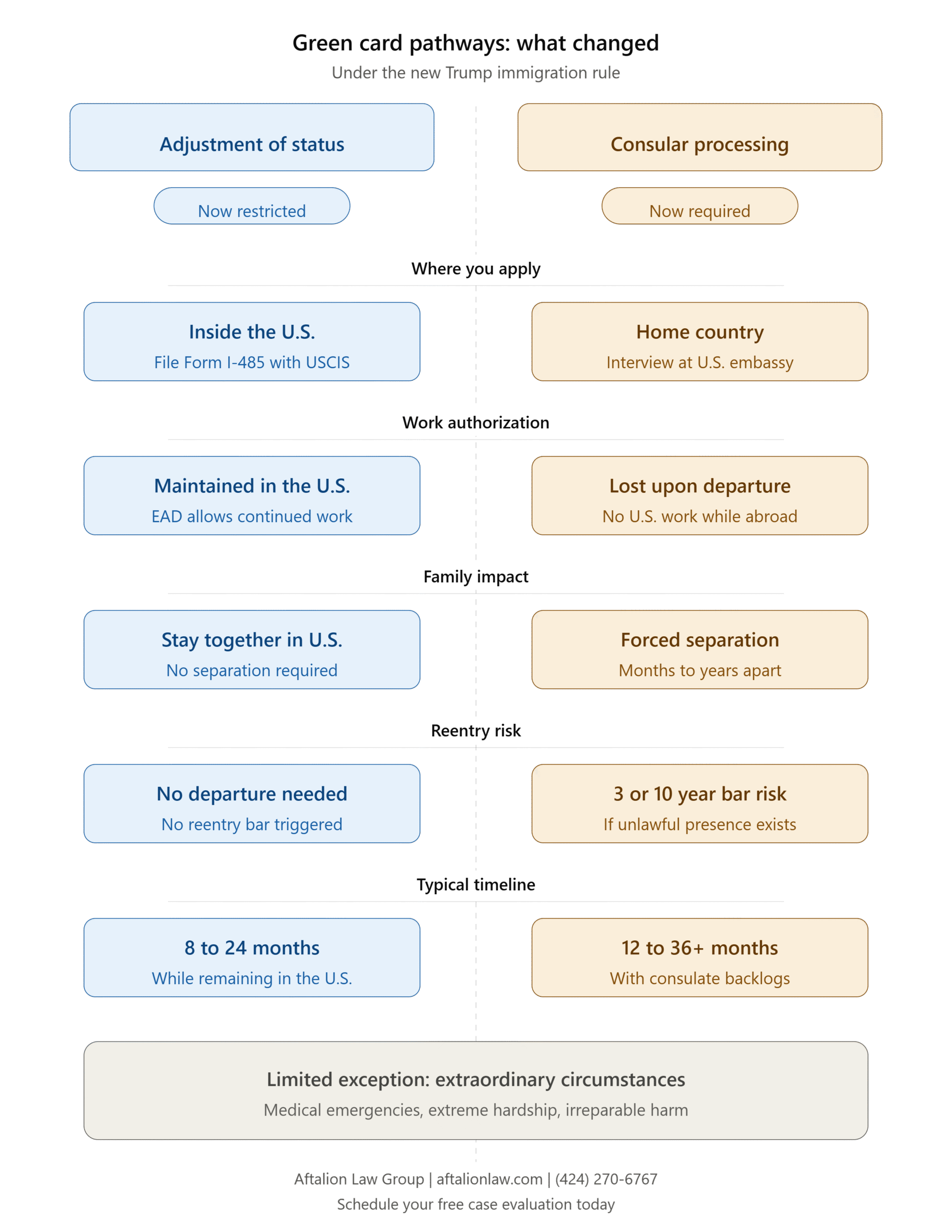
Understanding the difference between these two pathways is now more important than ever.
Adjustment of status (Form I-485) was the preferred route for eligible immigrants already inside the U.S. It allowed applicants to stay in the country, maintain work authorization, and avoid the uncertainty of international travel during the green card process.
Consular processing requires the applicant to leave the United States, attend an immigrant visa interview at a U.S. embassy or consulate in their home country, and wait abroad for approval before returning as a lawful permanent resident.
Under the Trump immigration rule, consular processing is now the default path for most applicants. The practical consequences include longer processing timelines, separation from family, potential job loss, and the risk of being subject to bars to reentry if the applicant has accrued unlawful presence in the United States.
The extraordinary circumstances exception exists but is vague and inconsistently applied. Medical emergencies, severe humanitarian concerns, or cases where departure would cause extreme hardship may qualify, but approvals are not guaranteed, and the standard is being applied strictly.
For a detailed comparison of how these two paths work, visit the visa processing overview for current information on each route.
What This Means for Pending Green Card Applications
If you currently have a pending I-485 application, the impact on your case depends on several factors.
Cases already in advanced stages of review may proceed differently than applications that were recently filed. However, the administration has signaled that the new policy applies broadly, including to cases filed before the rule change was announced.
The risk of being required to depart and continue your case through consular processing is real. Anyone who departs the U.S. without proper authorization, including advance parole, may trigger a three-year or ten-year bar to reentry depending on the length of any unlawful presence. The National Immigration Law Center provides updated guidance on what rights immigrants retain during this process. This makes understanding your current status before taking any action critically important.
If your application has been delayed unreasonably or you have not received a decision within normal processing timelines, a federal mandamus action may be an option to compel USCIS to act on your case. Aftalion Law Group has successfully used federal mandamus actions to move stalled green card cases forward for clients.
Can You Still Apply for a Green Card From Inside the U.S.?
In limited situations, yes. The extraordinary circumstances standard may apply in cases involving serious and documented medical conditions requiring ongoing U.S.-based treatment, U.S. citizen children or dependents who would face extreme hardship if the applicant departed, or situations where departure would result in irreparable harm that cannot be remedied through consular processing.
Applications for extraordinary circumstances require strong documentation, legal argumentation, and a clear showing that departure is not a viable option. These are not routine approvals. Working with an experienced immigration attorney significantly improves the chances of a successful request.
How Green Card Holders and Their Families Are Affected
The current trump immigration rule primarily targets those applying for permanent residence, not those who already hold a green card. However, the broader Trump deportation plan and current enforcement priorities have raised concerns among lawful permanent residents as well.
Green card holders can face removal under specific circumstances, including certain criminal convictions, fraud in the original application, or abandonment of U.S. residency. If you have questions about your status, the removal defense page outlines what protections exist and when legal representation is necessary.
Green card holders retain the ability to petition for certain family members, though family preference categories carry longer wait times than immediate relative petitions filed by U.S. citizens. The U.S. Department of State Visa Bulletin tracks current processing dates by category and country. If you are a lawful permanent resident considering a petition for parents or other relatives, speak with an attorney before filing to understand how the current policy may affect the timeline and process.
Waivers and Other Legal Options
For applicants who face bars to reentry or other grounds of inadmissibility, waivers may provide a path forward even under the new consular processing requirement. The attorneys at Aftalion Law Group regularly assist clients in identifying and filing the right waiver for their situation. The waivers practice page covers available relief, including the I-601 and I-601A provisional waiver, which allows certain applicants to apply for a hardship waiver before departing the U.S. for their consular interview.
Protect Your Green Card Case Before the New Trump Immigration Rule Narrows Your Options
The trump immigration rule is forcing families and individuals to make urgent legal decisions with serious long-term consequences. Whether you have a pending green card application, an approved petition waiting for a visa number, or concerns about how the new consular processing requirement affects your family, Aftalion Law Group is here to help. Our immigration attorneys serve clients across Los Angeles and throughout the United States.
Contact Aftalion Law Group today to schedule your free case evaluation with an experienced immigration attorney. Do not wait until your options narrow further.