
Written by Jonathan Aftalion, Esq. — Founding Attorney, Aftalion Law Group
(UCLA BA, Wisconsin JD, Witwatersrand LLM, dual CA + NY licensure, Super Lawyers Rising Stars)
In this blog, we'll explore:
Key Point:
- Adjustment of status lets you apply for a green card from inside the United States, while consular processing requires you to leave the country and complete the process at a U.S. embassy abroad.
- Consular processing is often faster for immediate relatives of U.S. citizens when USCIS backlogs are high, but it carries serious risks including three-year or ten-year reentry bars if you have accrued unlawful presence.
- Under Trump’s new immigration rule, consular processing has become the default path for most applicants, making it critical to consult an immigration attorney before choosing a route or departing the country.
If you are eligible for a green card, one of the first decisions you will face is whether to apply through adjustment of status or consular processing. Both paths lead to the same destination: lawful permanent residence in the United States. But they differ significantly in timeline, risk, cost, and practical disruption to your life. Aftalion Law Group helps families and individuals across Los Angeles and the United States understand which route applies to their situation and which one protects them most effectively under current policy.

What Is Consular Processing?
Consular processing is the method by which a foreign national applies for an immigrant visa at a U.S. embassy or consulate in their home country, rather than applying from inside the United States. It is one of the two official routes to obtaining a green card and is required for applicants who are outside the U.S. or who are not eligible to file for adjustment of status from within the country.
The consular processing path works as follows. After an immigrant petition such as an I-130 or I-140 is approved by USCIS, the case is transferred to the National Visa Center, which collects documents and fees before scheduling the applicant for an immigrant visa interview at the appropriate U.S. consulate. Once the interview is completed and the visa is approved, the applicant travels to the United States and is admitted as a lawful permanent resident upon entry.
Under the Trump administration’s recent rule changes restricting adjustment of status, consular processing has effectively become the default path for a much larger number of applicants than before. If you have a pending green card case or are about to apply, the family-based immigration and visa processing pages outline how these rule changes affect each petition type.
What Is Adjustment of Status?
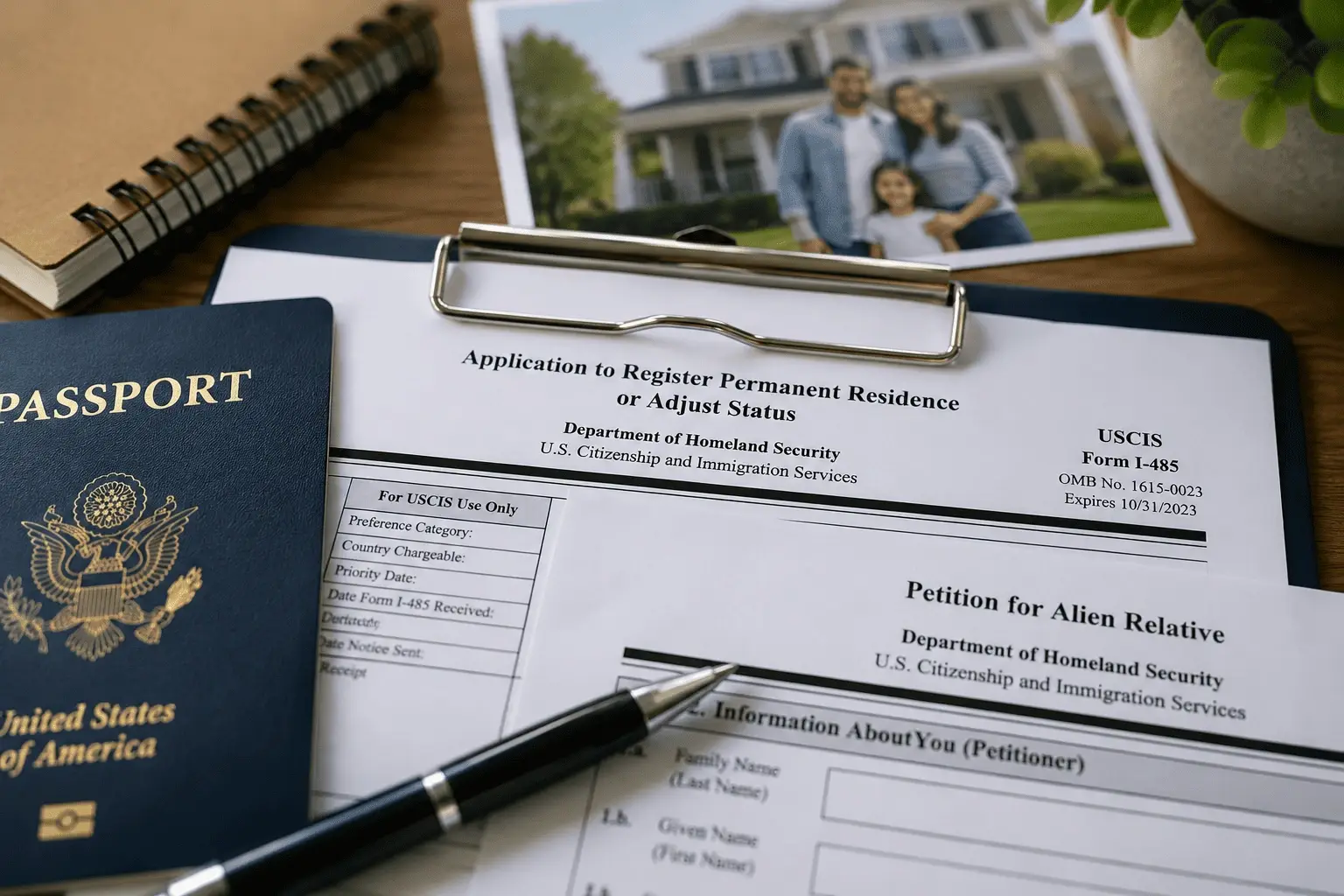
Adjustment of status is the process by which a foreign national already physically present inside the United States applies to change their immigration status to lawful permanent resident without leaving the country. The applicant files Form I-485 with USCIS and, if approved, receives their green card without having to attend an interview abroad.
This path was historically the preferred choice for eligible applicants because it allowed them to stay close to family, maintain employment, and avoid the uncertainty of international travel during a pending immigration case.
However, the Trump administration has significantly restricted who qualifies for adjustment of status, making consular processing the required route for a much larger share of applicants. Anyone currently inside the U.S. who assumed they could adjust status should confirm with an attorney whether that option is still available to them before taking any action.
How Long Will Consular Processing Take?
The timeline for consular processing varies depending on the type of petition, the applicant’s country of birth, and the workload at the relevant U.S. consulate or embassy.
For immediate relatives of U.S. citizens, including spouses, unmarried children under 21, and parents, there is no annual visa cap. Once the I-130 petition is approved and the National Visa Center processes the case, consular interview scheduling typically takes four to twelve months, depending on consulate location and current backlogs.
For family preference categories, including married adult children, siblings, and relatives of green card holders, wait times are substantially longer. These categories are subject to annual visa limits and per-country caps. Applicants from high-demand countries such as Mexico, the Philippines, India, and China face backlogs that can stretch for years or decades. The U.S. Department of State Visa Bulletin publishes monthly updates on current wait times for each preference category and country.
For employment-based cases, the National Visa Center processes the case after I-140 approval, and interview scheduling follows once the applicant’s priority date becomes current on the Visa Bulletin.
In general, consular processing is often faster than adjustment of status for applicants in immediate relative categories, especially when USCIS is experiencing high processing backlogs domestically. For preference categories, the wait is driven by the Visa Bulletin regardless of which path is chosen.
What Are the Risks of Consular Processing?
Consular processing carries several risks that adjustment of status does not.
Unlawful presence bars. If an applicant has spent more than 180 days in the United States without lawful status, departing the country to attend a consular interview can trigger a three-year or ten-year bar to reentry. Applicants who are unaware of this risk can inadvertently lock themselves out of the country by leaving for their interview. The I-601A provisional unlawful presence waiver exists specifically to address this issue and allows certain applicants to apply for the waiver before departing the U.S.
Visa denial abroad. When a consular officer denies an immigrant visa application, the applicant has limited recourse. Unlike a USCIS denial, which can be appealed or resubmitted in many cases, a consular denial is difficult to challenge. The doctrine of consular nonreviewability generally prevents U.S. courts from reviewing visa refusals, meaning a denial abroad can effectively close the door with little legal remedy.
Family separation. Consular processing requires the applicant to be physically outside the United States for the duration of the process, which can take months. For families with U.S. citizen children, elderly dependents, or other close ties, this separation carries high personal and financial costs.
Travel and logistical risks. Applicants must travel to their country of origin or the designated consulate country, which may involve safety concerns depending on the political or security situation in that country.
Document discrepancies under greater scrutiny. Consular officers conduct independent reviews and often scrutinize documents differently than USCIS officers. Green card marriage interview questions at consulates can be more intensive than domestic USCIS interviews, and inconsistencies in documentation are handled less flexibly abroad.
For couples going through the marriage-based green card process, reviewing common family-based visa interview questions in California before an interview, whether at a domestic USCIS office or abroad, can help avoid preparation gaps that lead to delays. The attorneys at Aftalion Law Group prepare clients for both USCIS and consular interviews and review all documentation before submission.
Adjustment of Status vs. Consular Processing: Which Is Faster?
The honest answer is that it depends on your specific situation.
Consular processing is generally faster when:
- You are an immediate relative of a U.S. citizen and have no unlawful presence issues
- USCIS domestic processing times are severely backlogged
- You are outside the United States and cannot legally enter to file I-485
Adjustment of status is generally faster when:
- You are already inside the U.S. with a valid visa and no admissibility bars
- Your priority date is current and USCIS processing times are reasonable
- You need to maintain work authorization and travel flexibility during the process
Under the current Trump immigration rule, many applicants who would previously have chosen adjustment of status are now being pushed toward consular processing by policy, not preference. This makes understanding the risks of consular processing more important than ever.
For applicants with approved petitions who have been waiting a long time without action, a federal mandamus lawsuit may be an option to compel USCIS or the State Department to move the case forward. The Congressional Research Service has analyzed processing delays across both adjustment of status and consular processing pathways, noting that backlogs have reached historic levels under current conditions.
Green Card Through Marriage: Adjustment of Status or Consular Processing?
For spouses of U.S. citizens, this is one of the most common questions an immigration attorney receives. The answer depends on whether the spouse is already in the United States and whether they entered lawfully.
A spouse who entered the U.S. lawfully on a valid visa and maintains valid status is generally eligible for adjustment of status. The process involves filing the I-130, I-485, and supporting forms together, attending a domestic USCIS interview, and receiving the green card without leaving the country.
A spouse who is outside the United States, or who entered without inspection, will typically go through consular processing. This involves the I-130 petition, National Visa Center document review, and a green card marriage interview at a U.S. consulate in the spouse’s home country.
For spouses who have accrued unlawful presence, an immigration attorney can assess whether the I-601A waiver applies before any departure is made. For specific guidance on your marriage-based case, speaking with a marriage green card attorney before filing anything is strongly recommended.
If your two-year conditional green card is expiring, the removal of conditions process is a separate step that applies after the initial green card is obtained, regardless of which path was used.
Talk to Aftalion Law Group Before You Choose the Wrong Path
Choosing between adjustment of status and consular processing is not a decision to make without legal guidance. The wrong choice, or an uninformed departure from the United States, can result in years of separation from your family and closed legal doors. Aftalion Law Group helps clients in Los Angeles and across the country navigate both pathways with a clear-eyed assessment of which option protects them best under the current Trump immigration policy.
Schedule your free consultation with an experienced immigration attorney at Aftalion Law today.
Frequently Asked Questions
Generally no. Most people who entered without inspection are not eligible to adjust status from inside the United States and must go through consular processing. Exceptions exist under INA Section 245(i) for certain individuals with immigrant petitions filed before April 30, 2001. Aftalion Law Group can assess whether any exception applies to your situation before you take any steps that could affect your eligibility.
Leaving the United States while a pending I-485 is on file, without first obtaining advance parole, results in your application being considered abandoned and automatically terminated. If you also have unlawful presence, departing can trigger a three-year or ten-year bar to reentry. Do not travel internationally while an I-485 is pending without first consulting Aftalion Law Group.
You are not legally required to have an attorney, but having one significantly reduces the risk of delays, document errors, and visa denials. Consular denials are very difficult to appeal, and inconsistencies in documentation are handled far less flexibly abroad than in domestic USCIS proceedings. The attorneys at Aftalion Law Group prepare clients thoroughly for consular interviews and review all supporting documents before submission.
No. Consular processing does not provide U.S. work authorization. Your spouse must remain outside the United States during the consular process and can only work in the U.S. after being admitted as a lawful permanent resident. This is one of the key practical disadvantages of consular processing compared to adjustment of status, where work authorization can be obtained while the I-485 is pending.
The National Visa Center, or NVC, is a U.S. government processing center that receives approved immigrant petitions from USCIS and prepares cases for consular interviews. The NVC collects required documents, fees, and biographical information from the applicant and petitioner before forwarding the case to the appropriate U.S. embassy or consulate for scheduling. The NVC stage typically takes weeks to several months depending on case type and current workload.
Your priority date is established when USCIS receives your immigrant petition, such as an I-130 or I-140. Each month the U.S. Department of State publishes the Visa Bulletin, which shows current cutoff dates for each preference category and country of birth. If your priority date is earlier than the cutoff date shown for your category and country, your date is current. Aftalion Law Group can help you read the Visa Bulletin and determine what it means for your specific green card case.
Recent Blogs